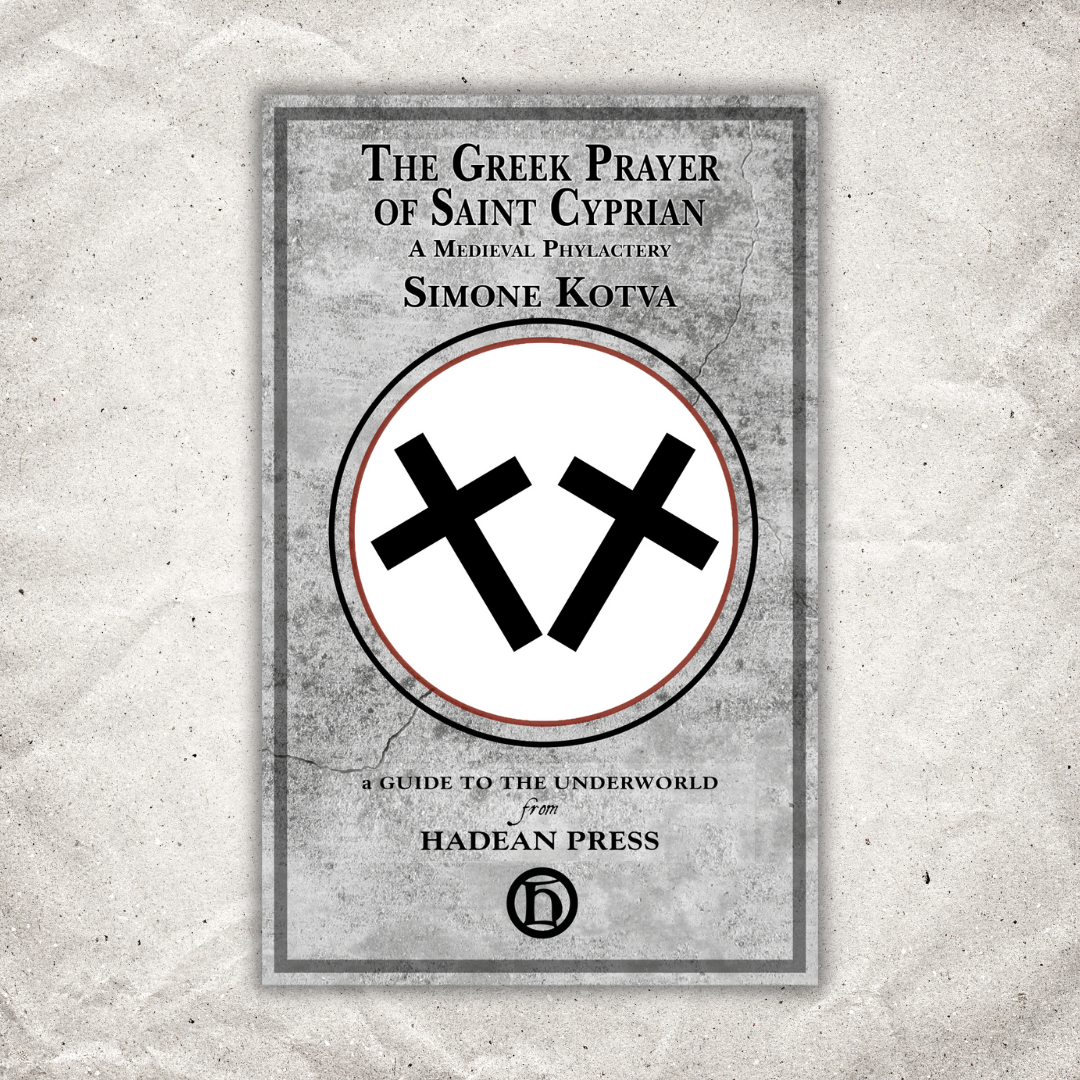
The Greek Prayer of St. Cyprian: A Medieval Phylactery
Couldn't load pickup availability
The Greek Prayer of St. Cyprian is a versatile piece of ancient Christian magic with roots in medieval Byzantium. An apotropaic prayer in which pagan sorcery and Christian exorcism meet, the Greek Prayer has enjoyed a tumultuous seven-hundred-year history. Declared “most loathsome superstition” by the Protestant Bishop John Fell and forbidden by the Inquisition, in Eastern Christianity the Prayer was included in liturgical handbooks and widely used as a healing formula.
The Greek Prayer also became the origin of many popular Cyprianic formulae found in European grimoires, such as the Grimoire of Pope Leo, the Portuguese and Spanish books of St. Cyprian, and the Scandinavian Black Books. Its Greek form, however, so relevant to the historical context of the legendary Sorcerer Saint, has managed to pass largely unnoticed in contemporary Cypriana.
This pamphlet provides the first English translation of a version of the Greek Prayer, accompanied with notes on its history and use.
The Greek Prayer of St. Cyprian: A Medieval Phylactery
Translated and introduced by Simone Kotva
ISBN 978-1-915933-51-5
A Guide to the Underworld
16 pages.

Guides to the Underworld
We've been producing our Guides since 2009 and have over 60 titles in print. From Jake Stratton-Kent's Spirit Work series, Catholic folk magic, Hoodoo, stellar magic, lunar magic, translations of historical treatises on magic, and enough practical magic to fill a lifetime, the Guides are an indispensable part of your magical journey.
In this series of pamphlets we adhere to:
"...the second idea of the radix of the word Pamphlet... that it takes its derivations from παν, 'all', and φιλεω, 'I love', signifying a thing beloved by all; for a pamphlet being of a small portable bulk, and of no great price, is adapted to every one's understanding and reading." (Curiosities of Literature, and the Literary Character Illustrated, Disraeli & Griswold, 1846, p. 91)
Because magic is for everyone.