


Iberian Books of Saint Cyprian

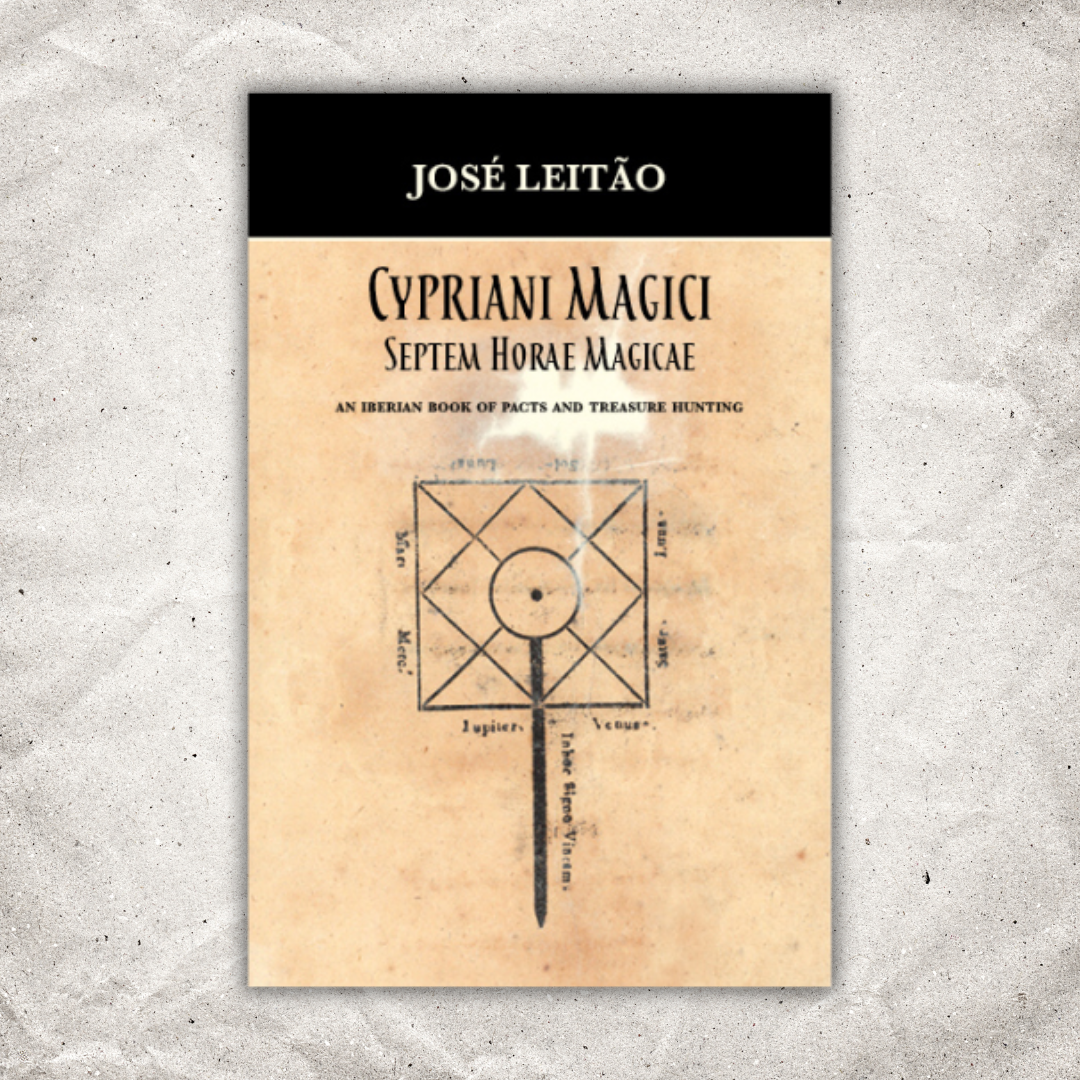
It was thus that, in 1888 the Portuguese philologist, ethnographer, and pedagogue Francisco Adolfo Coelho published a paragraph from a purported ‘authentic’ Book of Saint Cyprian he had seen, in passing, in the hands of one of his acquaintances – an old and weathered pre-printing-press thing, written in a garbled language and containing diabolical invocations and gruesome recipes, as if something taken out of a legend; a book he claimed was called the Cypriani Magici Septem Horae Magicae. Resting on nothing but his word, news of this text was shrugged off by any and all who investigated the Cyprian books for the next one hundred and forty years as an odd fluke, an impossible report or a mistake of some sort. This, until the words Septem Horae Magicae were unexpectedly found on a lost index card of the Portuguese National Library in 2021.
Transcribed, translated and published here for the first time, accompanied by an in-depth introduction and historical and contextual analysis by José Leitão, this short text, besides being a treasure hunting book, is a complex object, offering instructions and recipes for consecration incenses and various magical implements, explicitly non-Solomonic methods for the performance of a pact with the spirit Lucifuge Rofocale, and suggesting his local relationship with the Iberian folk figures of the mouras encantadas.
The Cypriani Magici Septem Horae Magicae presents itself as a rare window into the short but intense period when the Books of Saint Cyprian found themselves between manuscript and print, between folk and learned, and Iberia and Europe. It is a cultural treasure, an irreverent magic text and it poses more questions than it answers.

Contents:
Introduction
Books of Saint Cyprian in the sixteenth and seventeenth centuries
Books of Saint Cyprian in the eighteenth century
Books of Saint Cyprian in the nineteenth century
The Cypriani Magici Septem Horae Magicae
Concluding Remarks
Cypriani Magici Septem Horae Magicae Facsimile
Cypriani Magici Septem Horae Magicae Transcription
Cypriani Magici Septem Horae Magicae Translation
Bibliography